
Intech Blog
Daylight Saving Ends Nov. 1: Check Your Site Lighting Now
Daylight saving time ends the morning of November 1, 2026, and that single hour shifts sunset back to late afternoon almost overnight. For a business, that means a parking lot, entrance, or loading area that's coasted through summer on daylight is suddenly relying on fixtures that haven't run a real overnight shift in months. If a photocell has failed, a pole light has been buzzing since July, or a timer is still set for June sunsets, September is the month to find that out, not the first dark Monday in November when a customer or employee is walking to their car in the pitch black.
Minnesota loses daylight fast once fall hits. The stretch from late September through early November can shave off well over an hour of evening light in just a few weeks, and this year's time change lands on the earliest possible date under federal law. That's a hard deadline, and it's a good one to plan around, especially with electricity rates on the move. Xcel Energy has asked state regulators to approve a rate increase of roughlypercent over the next two years, on top of a summer that already saw customers hit with an unusual run of conservation requests during a long stretch of 90-degree days. Lighting that's inefficient or poorly aimed isn't just a liability risk anymore, it's a bigger line item on the utility bill too.
We get calls every fall from property managers and business owners who assumed their lot lighting was fine because nobody had complained. Then the clocks change, the lot goes dark at 5:30 instead of 8:00, and every dead fixture and dark corner becomes obvious at once, usually right as an insurance adjuster or a tenant is asking questions. A quick check now beats an emergency call in November.
Why lighting becomes a liability issue, not just a maintenance issue
Property owners generally have a duty to keep common areas like parking lots, walkways, and entrances reasonably safe, and courts have repeatedly treated inadequate outdoor lighting as evidence of that duty being breached. Poor lighting shows up in two very different kinds of claims: slip-and-fall cases where someone couldn't see a curb, a pothole, or ice, and negligent security claims where a criminal act happened in a dark corner of a lot that should have been lit. Neither one is a good conversation to have with your insurance carrier after the fact.
None of this means you need a lighting engineer on retainer. It means walking your property at dusk once a year, before the days get short, and fixing what you find instead of waiting for a complaint or a claim.
The failures we find most often this time of year
A lot of site lighting problems don't show up until fall because the fixtures simply weren't needed to run a full night's cycle over the summer. Once the nights get longer, weak points get exposed fast.
- Photocells that have gone bad or gotten dirty, so a fixture never turns on or never turns off
- Timers left on a summer schedule, leaving lights dark during the exact hours drivers and pedestrians need them most
- Flickering or humming fixtures, which usually points to a failing ballast or driver, not just a dying bulb
- Pole bases and wiring damaged by summer storms or lawn equipment, sometimes not obvious until you look closely
- Water intrusion in fixture housings from a season of rain, which shows up as corrosion or intermittent outages
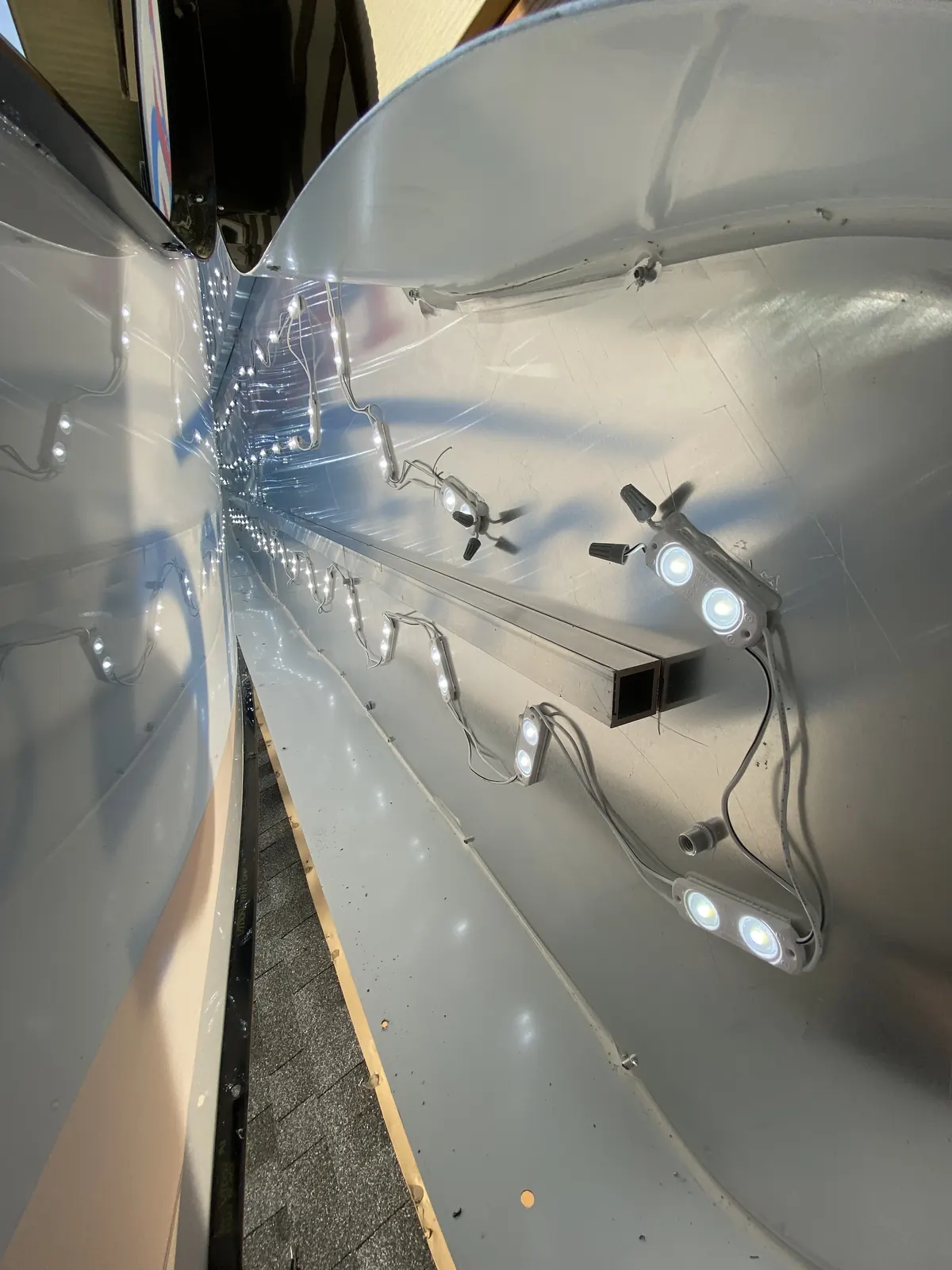
- Illuminated pylon and monument signs with dead sections or flickering channel letters, which hurt visibility and curb appeal after dark
A pre-season walk you can safely do yourself
You don't need to touch a fixture or open anything up to catch most problems. Walk the property right around dusk, before it's fully dark, and note anything that looks off.
Look for poles or fixtures that are out completely, ones that flicker or hum, and spots where the light from two fixtures should overlap but leaves a dark gap instead. Check that your pylon or monument sign is fully lit and legible from the road. If you notice a breaker for exterior lighting has tripped, it's fine to reset it once, but if it trips again, stop and call an electrician rather than resetting it repeatedly. A breaker that keeps tripping is telling you something is actually wrong downstream.
Where an LED retrofit pays for itself
If your lot is still running older HID or metal halide fixtures, fall is a smart time to look at an LED lighting retrofit rather than just replacing dying fixtures one at a time. LED site lighting draws a fraction of the power of older technology, holds its output far longer before it degrades, and gives you more even coverage across a lot instead of bright rings under each pole with dark gaps between them. With utility rates trending upward, cutting the wattage on fixtures that run eight to twelve hours a night, every night, is one of the more predictable ways to bring an operating budget down.
When to bring in a licensed electrician
Anything beyond swapping a bulb on a fixture you can safely reach belongs to a licensed electrician. That includes replacing photocells and timers, diagnosing a fixture that's tripping a breaker, tracing wiring damage in or around a pole base, and any work on the circuits feeding a pylon or monument sign. Pole bases and underground feeds are also a common place where aging or storm-damaged wiring hides until someone finally investigates a fixture that's gone dark. A thorough look with a thermal or infrared inspection can also catch loose connections in a panel or lighting contactor before they turn into a failure on the coldest, darkest night of the year.
Frequently asked questions
When does daylight saving time end in 2026?
Daylight saving time ends on Sunday, November 1, 2026, when clocks fall back one hour at 2 a.m., which is the earliest possible date it can occur under current federal law.
Are businesses legally required to maintain parking lot lighting?
Requirements vary by property and local rules, but property owners generally have a duty to keep common areas reasonably safe, and courts have treated inadequate lighting as a factor in both slip-and-fall and security-related injury claims. Check with your insurance carrier or attorney about specific obligations for your property.
Why do my parking lot lights turn on at the wrong time after the time change?
Fixtures controlled by a photocell adjust automatically because they respond to actual light levels, not a clock. Fixtures controlled by a timer will run on whatever schedule was last programmed, so they need to be manually updated when sunset times shift.
How often should commercial site lighting be inspected?
A twice-a-year walkthrough, once before the fall time change and once in spring, catches most problems before they become outages or liability issues. Properties with heavy foot traffic or higher security concerns may benefit from more frequent checks.
Can switching to LED site lighting actually lower my electric bill?
Yes, LED fixtures typically use significantly less energy than older HID or metal halide lighting for the same or better light output, and with utility rates trending upward that difference shows up directly on the electric bill over a year of nightly operation.
What should I do if a parking lot pole light is flickering or the pole feels loose?
Stay away from the pole and fixture and call a licensed electrician. A flickering fixture often points to a failing driver or loose connection, and a loose or damaged pole base can be a sign of wiring or structural damage that needs a professional evaluation.
Get Ahead of the Early Dark
Intech Corporation inspects and repairs parking lot, site, and sign lighting for businesses across the Twin Cities, from photocell and timer fixes to full LED retrofits.
Schedule a Lighting Inspection →